
Since more than half of all Blogger users are outside the U.S., I recently took a virtual tour of blogs around the world from Armenia to Zambia. It is amazing to see that so many people create and update their free websites in such a wide variety of languages - all of them using an English-only version of Blogger. If these folks can create that much content working with a foreign language tool, what could they accomplish if Blogger were available in their own languages?
We'd like to find out. The Blogger team has begun the process of internationalizing our service. While the posting interface and some other pages throughout Blogger are not yet translated, they soon will be. Meanwhile, right now native speakers of French, German, Spanish, Italian, Japanese, traditional Chinese, simplified Chinese, Brazilian Portuguese, and Korean will see an increasingly familiar version of Blogger in their own languages when they sign in.
We're all super excited that even more people around the world will be able to put their voice on the web using a Blogger interface that feels more like home.
- Biz Stone, Blogger team
Monday, November 15, 2004

Wednesday, November 10, 2004
Google's index nearly doubles.
You probably never notice the large number that appears in tiny type at the bottom of the Google home page, but I do. It's a measure of how many pages we have in our index and gives an indication of how broadly we search to find the information you're looking for. Today that number nearly doubled to more than 8 billion pages. That made me smile.
Comprehensiveness is not the only important factor in evaluating a search engine, but it's invaluable for queries that only return a few results. For example, now when I search for friends who previously generated only a handful of results, I see double that number. These are not just copies of the same pages, but truly diverse results that give more information. The same is true for obscure topics, where you're now significantly more likely to find relevant and diverse information about the subjects. You may also notice that the result counts for broader queries (with thousands or millions of results) have gone up substantially. However, as with any search engine, these are estimates, and the real benefit lies with the queries that generate fewer results.
The documents in Google's index are in dozens of file types from HTML to PDF, including PowerPoint, Flash, PostScript and JavaScript. Together these pages represent a good chunk of the world's information, but hardly all of it. That's why we keep building more advanced systems for crawling the web and creating more sophisticated indices to sort what we find. So 8 billion pages is a milestone worth noting, but it's not the end of the road. The real test is how well we do in finding what you want from within those pages. We'll keep improving that too.
Bill Coughran
V.P., Engineering
The feeling is mutual
When people ask me about what it's like to work at Google, I can only say it's a lot of fun when Larry asks, "How can you help as many people as possible earn a living from Google?" Our answer to that question today is the Google Advertising Professionals program. It's our first step in establishing direct working relationships to everyone who wants to work with us to provide relevant search results or relevant ads.
The program makes it easy to manage lots of AdWords accounts for advertisers and clients, and offers a way for providers to showcase their proficiency with AdWords. And we've created an online learning center with dozens of self-paced lessons on the most up-to-date AdWords information.
There are already thousands of firms and individuals who provide services related to AdWords, and many who could use those services. We hope this program helps them connect in meaningful and rewarding ways.
-- Sumit Agarwal
Product Manager
Tuesday, November 9, 2004
Give up?
Okay, so WWWDOT - GOOGLE = DOTCOM, and M and E are interchangeable, and there are no leading zeros. Can you solve this equation? Turns out plenty of you can. In fact, maybe you've already taken the Google Labs Aptitude Test, which we published a couple months ago as a recruiting tool and general shout-out to our math-and-CS-minded peers.
Anyway, where WWWDOT - GOOGLE = DOTCOM is concerned...
Off[General::"spell1"]
chars=Characters/@ToLowerCase/@{"WWWDOT","GOOGLE","DOTCOM"};
uchars=Union[Flatten[chars]];
eqn = First[#]-Plus@@Rest[@]&[FromDigits[#,10]&/@chars]==0;
...and so on. If you followed that, you might want to check out MathWorld.com's impressive list of solutions to the thornier GLAT problems. The authors, Ed Pegg, Jr. and Eric Weisstein, declined to tackle most of the GLAT's more whimsically or philosophically inclined essay questions (wimps), but they did, with considerable aplomb, meet the challenge of composing a search-seasonality-related haiku:
MathWorld's search engine
seemed slowed this May. Undergrads
prepping for finals.
Congratulations for a job well done to Ed, Eric, and everyone else who sent in their own solutions. Those Googlers who understand this stuff were impressed with the quality of the work we received. And the rest of us enjoyed the haiku.
Michael Krantz
Google Blog Team
Saturday, October 30, 2004
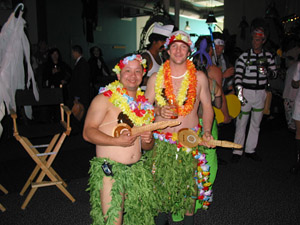
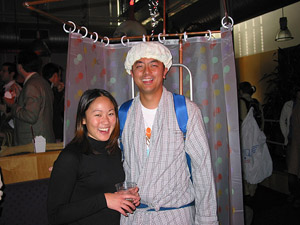
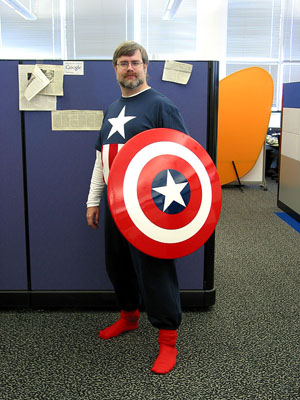
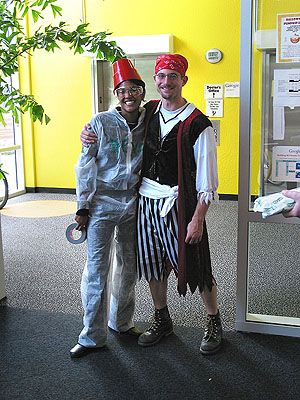
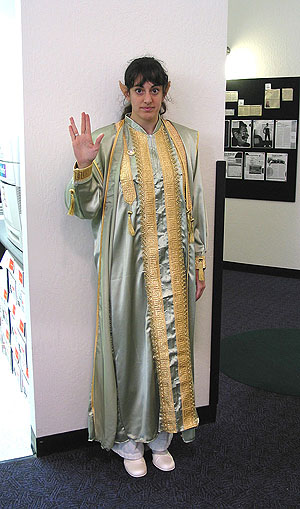
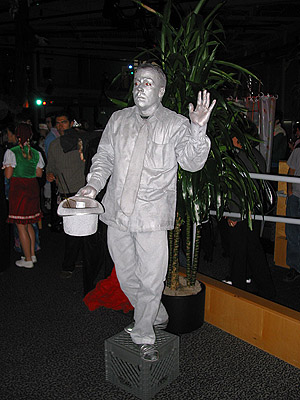
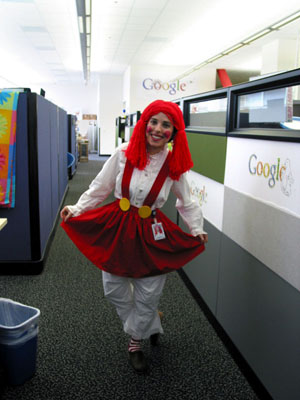
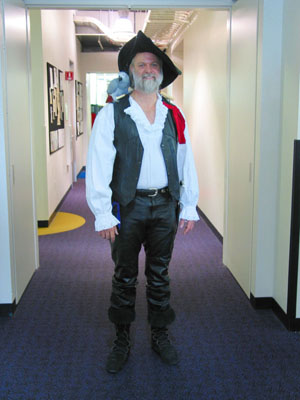
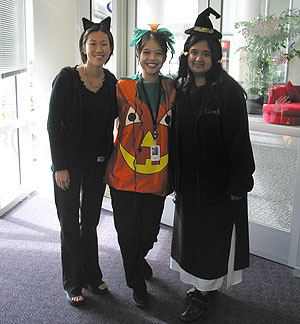
Boo who?
Googlers tend to be disturbingly serious about Halloween. Here are a few of our favorite costumes spotted yesterday around the Googleplex.
Google Blog Team
Google Blog Team
 |  |  |
 |  |  |
 |  |  |
 |  |  |
Friday, October 29, 2004
A very puzzling Googler
Here at Google we like puzzles. A lot. We do them to relax, we use them in recruiting campaigns, and we're even a sponsor of the World Puzzle Championship. So, as Google's official in-house puzzle geek, I'm pleased to report that recently, after a two-year dry spell, Team USA finally recaptured the World Puzzle Championship title, our eighth victory in the 13-year history of the championship.
In fact, "13" was a common theme for this year's contest, which was held in Opatija, Croatia, a small town on the Adriatic Coast; all the individual rounds had 13 puzzles, and all the time limits were multiples of 13 minutes. Some of the more interesting events included a "relay" round where the solution to each puzzle was needed to solve the next puzzle, and two rounds where information from the 12 initial puzzles were needed to solve the final 13th puzzle. Here's an example of one particularly nasty brain-teaser from that round:

(For those readers who haven't solved it already, shade in nine regions such that no two shaded regions touch (even at a corner) and that eight of them "point" in different directions. The numbers outside the grid tell you how many shaded regions there should be in that row or column.)
I wound up placing 5th in the individual rankings; first place went to Niels Roest from The Netherlands in a very impressive comeback victory in the playoffs. But the most enjoyable aspect of the trip may have been the travel itself, which took us from Munich, Germany to Trieste, Italy, through Slovenia and across the Istrian peninsula to the Hotel Ambasador (yes, only one S), where I enjoyed a stunning 180-degree view of the Mediterranean from my room (when I wasn't solving puzzles, of course).
I can't wait to try out for next year's competition in Hungary!
Wei-Hwa Huang
Software Engineer
In fact, "13" was a common theme for this year's contest, which was held in Opatija, Croatia, a small town on the Adriatic Coast; all the individual rounds had 13 puzzles, and all the time limits were multiples of 13 minutes. Some of the more interesting events included a "relay" round where the solution to each puzzle was needed to solve the next puzzle, and two rounds where information from the 12 initial puzzles were needed to solve the final 13th puzzle. Here's an example of one particularly nasty brain-teaser from that round:
(For those readers who haven't solved it already, shade in nine regions such that no two shaded regions touch (even at a corner) and that eight of them "point" in different directions. The numbers outside the grid tell you how many shaded regions there should be in that row or column.)
I wound up placing 5th in the individual rankings; first place went to Niels Roest from The Netherlands in a very impressive comeback victory in the playoffs. But the most enjoyable aspect of the trip may have been the travel itself, which took us from Munich, Germany to Trieste, Italy, through Slovenia and across the Istrian peninsula to the Hotel Ambasador (yes, only one S), where I enjoyed a stunning 180-degree view of the Mediterranean from my room (when I wasn't solving puzzles, of course).
I can't wait to try out for next year's competition in Hungary!
Wei-Hwa Huang
Software Engineer
Thursday, October 28, 2004
Click the vote
As you might have heard, there's an election coming up. If you're as obsessed as we are (okay, if you're half as obsessed as we are), we'd like to suggest a few ways that Google can help enable your political jones.
Google News, of course, is constantly packed with a crazy amount of stories, from wire service reports to partisan pundits, global opinion to intrepid bloggers. Setting up a few Google Alerts will keep your in-box up-to-the-minute with every last late-breaking poll result, local ballot initiative, Electoral College analysis and, alas, hanging-chad-related court filing. And stay tuned to Google Zeitgeist for our ongoing analysis of the most recent web search trends.
But most important - get out and vote!
Michael Krantz
Google Blog Team
Subscribe to:
Posts (Atom)
