.:[Double Click To][Close]:.
0
0
0

Friday, September 30, 2005

Ants unearthed with Google Earth


At a time when the power of information technology doubles every 12 to 15 months and extends to capture every scrap we have, digitizing biodiversity information is a final frontier for IT. It's an essential step to ensure society maintains and hopefully increases bio-literacy. Toward this end, there's Antweb. It's a project from the California Academy of Sciences that has incorporated the Google Earth interface to provide location-based access to the diversity and wonder of ants: from your backyard to the Congo Basin.

As society advances, literacy increases and bio-literacy decreases. If you're illiterate, you may view a library as thinly sliced stacks of firewood; a Google search engine is meaningless. If you are bio-illiterate, a forest is at best a green blob to be consumed. If you are bio-literate, you see the diversity of the forest and understand that each animal, each plant, tells a story and has a place.

Google has helped us achieve free and democratic access to information, but now, with Google Earth, it's taken an important step to promote bio-literacy. Together with other institutions in the Bay Area, Google is uniquely poised to take on this enormous task.

There are two ways people need to access information on biodiversity: either have a name for which they want more information, or they are at a location and want to know what they will find there. On Antweb, you can access information about ants via location – and Google Earth allows for any scale of access via location. So you can be in Santa Clara County and see what ants you are likely to find. Soon you will be able to create a field guide for ants in any location defined in Google Earth.

We tried to get NASA’s help to develop such a system for years with their mapping expertise and data, but Google Earth answered the call first. I am so impressed with Google that I have named an ant I recently discovered in Madagascar Proceratium google. Its bizarrely-shaped abdomen is an adaptation for hunting down obscure prey: spider eggs. Here's what it looks like.
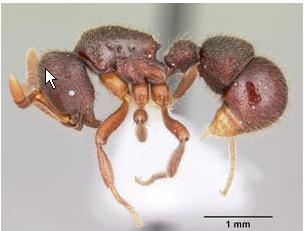
I hope that Google will continue applying its skills to serve biodiversity data to conservation planners and the general public. Google has given us a tool to connect the 6 billion people on earth with our remaining biodiversity. Antweb welcomes any form of collaboration to help achieve this goal – and may the ants be with you.

Thursday, September 29, 2005

This is "beach-front"?


Have you ever wondered if that "beach-front" condo really is beach-front? Recently I planned a trip to Hawaii and saw one particularly breathless condo listing that described the property as being just 400 "steps" from the beach. Now having seen the location, I think the owner was obviously very tall...

Using the measure feature in Google Earth, you can take a little bit of the guesswork out of finding the perfect accommodations. Just follow these three simple steps:

1) Fly to your area of interest in Google Earth (if you don't have it, get it here).

2) Click the Email button on the nav panel in the lower right, and send the property owner a JPG screenshot of the area. Ask him or her to identify which place is theirs.

3) Select Measure from the Tools menu and choose to see the distance in feet, yards, miles (or even smoots, if you insist).

This volt's for you


How many Googlers does it take to screw in a lightbulb? None, if you use solar power. We just had our first Google Environmental Fair to help introduce employees to various sustainable practices, low impact living and natural products. This event kicks off an ongoing worldwide effort by Google to bring environmental best practices to our offices and employees. Companies are finding that "going green" isn't just good for the earth but can lead to, say, superior design or healthier lifestyles.

Earlier this year Google further encouraged responsible energy technologies by offering a cash incentive to employees who decide to purchase a fuel-efficient vehicle. The net result? I'm guessing that the Mountain View Googleplex has the highest concentration of Toyota Priuses in the Northern Hemisphere. As an added bonus to the environmental benefits, California hybrid owners can now drive in the carpool lane without needing additional passengers. Score! Of course with a parking lot full of similar-looking cars one must take steps to stand out. I'm thinking Twenty-Twos and flames.

Actually, the most appropriate car accessory might be one offered by another Environmental Fair participant, a Terrapass. Donations to this progressive organization are used to "eliminate the equivalent of your car's carbon dioxide pollutions" through financing projects which reduce industrial emissions. So whether you're driving a new fuel-efficient vehicle or a more traditional car, you can leave a smaller environmental footprint.

Korean Horror Queen Ha Ji-Won

Image hosted by Photobucket.comHa Ji-won born in June 28, 1979, made her television debut in 1997 on KBS TV. She won a Grand Bell award as the Best New Actress of 2000 with her debut film Truth or Dare, and a Blue Dragon award for Best Supporting Actress with her second film, the popular melodrama Ditto (2000). After achieving wider public recognition as a "horror queen" for her roles in Ahn Sung-ki's films A Nightmare and Phone, she has branched out into a variety of roles such as that of a cheerleader in Sex is Zero, which was one of most successful comedies of the year 2002 in South Korea.

Thanks to the huge success of her TV drama, Damo in which she starred as a female detective in the Chosun Dynasty and Something That Happened in Bali in which she played a poor girl who was loved by two rich men played by Jo In-sung and So Ji-seop, she gained a reputation as an A-list actress. Her subsequent roles in three comedies -- Reversal of Fortune, 100 Days With Mr. Arrogant, and Love, So Divine -- were not as successful with audiences, however. In early 2005 she starred in the melodrama Daddy-Long-Legs, based on a famous novel by Jean Webster.

Ha's next role saw her once again play a Chosun-era female detective, this time in acclaimed director Lee Myung-Se's Duelist. Probably her highest-profile role to date, the film sees her teams up with Ahn Sung-ki to catch an elusive criminal played by Kang Dong-won.

Wednesday, September 28, 2005

Attention, frequent flyers


Googlers aren't the only ones to spend time on planes – many people suffer the effects of "Economy Class Syndrome." Here are some tips even for flying veterans – or for that matter, those taking long road, train or bus trips, as similar advice applies. Much of this information can be found at the helpful site AirHealth.

Economy Class syndrome causes blood clots that develop in the legs (deep venous thrombosis, DVT) as a result of prolonged air travel. "Prolonged" can mean a 2-hour flight – and after 2 hours, the risk increases hourly, even if you change flights. If the clot breaks off and goes to the lungs (pulmonary embolus, PE) it can cause death.

Of course, this syndrome can easily occur in business or first class seats too – but it happens more in economy simply because there are more seats and therefore more people sitting.

Sounds obscure, you say? It's not. Some 3 to 5 percent of air travelers develop blood clots, most of which dissolve naturally. The few that don't have significant morbidity and mortality, but most of these can be prevented. However, the more frequently you fly, your chance of developing them goes up: frequent business travelers are about 50 times more likely to develop clots.

Often there are no symptoms until several days after the flight, and the DVT may be mistaken for a cramp. Symptoms may include:
  • Sudden swelling in one leg (a little swelling in both legs is usually normal)
  • Cramp or tenderness in one lower leg
  • Bruise or swelling behind a knee
Chest symptoms (PE) usually appear 2-4 days or more after the initial blood clot, and may include:
  • Shortness of breath, rapid breathing, panting
  • Cramp in your side, painful breathing
  • Chest pain, sometimes shoulder pain
  • Fever
  • Coughing up blood
  • Fainting
If you're thinking this doesn't happen to healthy road warriors, you'd be wrong. Being athletic is a major risk factor, because the slower pulse and resting blood flow rate may lead to increased stasis. Others who need to be on guard for DVT are:
  • Those who've had recent surgery or an injury. Avoid surgery 30 days before and after travel.
  • Personal or family history of DVT
  • Cancer, heart disease, diabetes, and obesity
  • Women who are pregnant, or are taking birth control pills or other hormone therapy
I think I have your attention now - so how do you prevent DVT when traveling?
  • Walk when possible on the plane (or bus or train).
  • Do leg flexing exercises at 30-60 minute intervals. Extend your legs and flex your ankles, pulling up and spreading your toes, then pushing down and curling the toes. Or rotate the ankles by making circles in the air.
  • If there isn't room to extend your legs, start with your feet flat on the floor and push down and curl your toes while lifting your heels. Then, with your heels back on the floor, lift and spread your toes. Repeat this heel-toe cycle five times or more.
  • Exercise your thigh muscles by sitting with your feet flat on the floor and slide your feet forward a few inches, then slide back and repeat. Or extend the legs if possible and isometrically flex thigh muscles.
  • Avoid crossing your legs, or wearing constrictive clothing (knee braces or tight garments, elastic support hose. (Compression hose have been proven effective, however).
  • Stay hydrated - but only with non-alcoholic, non-caffeinated beverages like a Virgin Mary (no vodka), and preferably electrolytic drinks (Gatorade type) – 1 cup every 1-2 hours. Drinking lots of plain water is not recommended (on long flights it can contribute to thicker blood viscosity, which may lead to clots).
  • If you have risk factors (such as history of DVT) talk to your doctor, since these require prescriptions. (Note that contrary to popular belief aspirin does not help prevent these clots because aspirin mainly affects the arterial and not the venous circulation.)
  • Though another standard recommendation is to avoid sleep, I think that would be cruel and unusual punishment given the severe deficiency of entertainment on these long hauls.
Finally, if you think have DVT, do not massage the leg - it can break off the clot and lead to PE. Call your doctor and let him or her know that you have traveled recently, and are having pain or swelling in one leg. The proper test then would be an ultrasound of the leg (not invasive or painful).

Want to read more? There's an extensive list of references of studies at the National Library of Medicine's PubMed service.

Wishing you safe and healthy trips!

Monday, September 26, 2005

We wanted something special for our birthday…


Google opened its doors in September 1998, and we’ve been pursuing one mission ever since: to organize the world’s information and make it universally accessible and useful. For our seventh birthday, we are giving you a newly expanded web search index that is 1,000 times the size of our original index.

I’m proud of everything we’ve accomplished in the years since Larry Page and Sergey Brin set up the first Google data center in Larry’s dorm room at Stanford. Today, along with web search based on Larry and Sergey’s original BackRub search engine, we offer specialized search for everything from satellite images to academic papers, local business info to your own computer. We’ve also built software for email and mobile services, photo management and computer-to-computer voice calling, to name just a few things.

But search remains our heart and soul, so I’m especially pleased by this latest expansion of our index, which makes Google more than 3 times larger than any other search engine. See for yourself how effective the new Google search index can be. Come up with a search query that's special to you (your name, your elementary school, and your favorite animal, for example) - a combination of words that is likely to exist on just a few web pages out of the billions we've indexed, a few needles scattered in the Internet’s endless haystack. Ready? Let’s go.

Everybody won't hate this


For all the talk about Internet TV, it's actually not so easy to watch a major network program on your own computer - especially one that's on the (bigger) small screen right now. But here's one you can watch: the new fall season premiere of Everybody Hates Chris, a lightly fictional take on Chris Rock's anxiety-ridden junior high school days. It first ran last Thursday on UPN, and for the next four days you can watch the entire first episode through Google Video.

When you're watching young Chris' travails, you'll see them on the new release of Google Video. There's no viewer to download, and the bigger video window (which expands automatically to your browser size) is now compatible with Mac and Linux as well as Windows. You can skip around in the video and start watching it instantly, even beyond what's been buffered. And you can watch a 10-second snippet of playable videos right on the results page - making it easier to decide whether you want to commit to the whole thing.

The era of the couch potato is so over. We're rooting for the desk (and laptop) potato.