
Wednesday, November 2, 2005
O, Canada (among others)
I've been working on the personalized homepage from Victoria, B.C., and I've never been psyched to have to sign in to the U.S. version every morning. While Seattle's pretty close, I'd prefer to have the actual weather for Victoria -- and have it in Celsius. Now I can, because today we expanded the personalized homepage to 16 new regions: Australia, Brazil, China, France, Germany, India, Italy, Japan, Korea, Mexico, Netherlands, Russia, Spain, Switzerland, UK, and ahem, Canada.
Now I can enjoy my morning Timbits with a Google homepage -- Canadian-style.

Flu season is upon us
It's official: flu season -- in the northern hemisphere, where flu hits between October to May -- has begun. (In the southern hemisphere, of course, it's the other half of the year, and in the tropics, one can catch the flu year-round.) Today I'll focus on the northern hemisphere, but the same ideas apply at different times in other locales.
Please note that this is general information, and not a substitute for medical advice; contact your own doctor with questions about your health.
The sources for the information below are: Medical Letter, Up To Date, the NIH's MedLine Plus, the Centers for Disease Control, and Lung USA.
Who should get a flu shot?
Generally, those wanting to reduce their chance of getting sick. It's especially recommended for the following high-risk groups:
- People aged 50 and older
- Women who are or will be pregnant during the flu season
- Adults and children 6 months and older with chronic heart, or lung conditions including asthma, metabolic diseases such as diabetes, chronic kidney disease, or weakened immune system such as with HIV or with medications, and any kind of brain or spinal cord disorders
- Children 6 months to 18 years who are on long term aspirin therapy
- All children 6-23 months of age
- All the contacts of people in these high-risk groups
Other than your doctor's office, try Flu Clinic Locator to see where you might be able to get a shot.
Who shouldn't get one?
- People with severe allergy to eggs
- People who currently have a fever
- Children less than 6 months old
- People who have had Guillane Barre syndrome (a paralytic condition) within 6 weeks of getting a flu shot in the past
When's best to get one?
It's optimal to get a shot in October or November (especially for the high-risk groups noted above), but you can also benefit in December or later.
Types of vaccines
- A flu shot, made from an inactivated vaccine, which contrary to popular belief cannot give you the flu.
- A flu nasal spray, an attenuated live vaccine. Because this can at least theoretically cause transmission, it should only be given to healthy people ages 5-49 who are not pregnant, not healthcare workers, or contacts of anyone who is immuno-suppressed.
Effectiveness
Within about 2 weeks, the shot is fully effective, and usually the effect lasts for 6 months or longer. A protection rate of 50-80 percent is the norm.
Recognizable flu symptoms
These are usually more severe than cold symptoms, and include sudden onset of high fever (101 or higher), severe muscle aches, headache, cough, sore throat, and a general miserable feeling. Symptoms may last 2-7 days, but if complications such as pnuemonia occur, the course may be longer.
How to treat the flu
Treatment is mainly designed to reduce the symptoms with
- rest
- fluids
- acetominophen (like Tylenol) -- not aspirin, especially in those under 18, to avoid Reyes Syndrome, which is a serious neurological disease
- antiviral medications (most effective if started within the first 2 days of onset of symptoms)
Unless there is a secondary complication (e.g. ear infection, sinusitis), antibiotics are not typically prescribed. And the jury is out on alternatives such as Vitamin C or herbal products. (Recently, echinacea was shown to be ineffective for cold treatment.)
Here's hoping you can stay healthy this winter!
Monday, October 31, 2005
Discovering hard-to-find books
Tomorrow is the day we said we'd resume scanning in-copyright works with our library partners as part of our initiative to build a card catalog of books with Google Print. We are in the process of resuming scanning (it may take a little time), so you should soon be able to search across more books from our partner libraries at print.google.com. We've already had great success working with publishers directly to add their works to our index through our Publisher Program, and when we add books with publisher permission, we can offer more information and a much richer user experience.
As always, the focus of our library effort is on scanning books that are unique to libraries including many public domain books, orphaned works and out-of-print titles. We're starting with library stacks that mostly contain older and out-of-circulation books, but also some newer books. That said, we want to make all books easier to find, and as we get through the older parts of the libraries we'll start scanning the stacks that house newer books.
These older books are the ones most inaccessible to users, and make up the vast majority of books – a conservative estimate would be 80 percent. Our digital card catalog will let people discover these books through Google search, see their bibliographic information, view short snippets related to their queries (never the full text), and offer them links to places where they can buy the book or find it in a local library.
We think that making books easier to find will be good for authors, publishers, and our users. We're excited to get back to work making a comprehensive, free, full-text card catalog of the world's books a reality. Happy searching!
Friday, October 28, 2005
Saying thank you with pictures
I recently got married and wanted to send out thank-you notes together with hundreds of photos our guests took using the cameras we put on the tables. Picasa made the process super easy.
In Picasa, select the folder with your pictures. Click the "Gift CD" button and follow the instructions to set your picture size and CD name. To add a nice effect, check the "Include Slideshow" box -- this adds a slideshow presentation that plays when the CD is launched (way more fun than a boring list of files). For recipients who might enjoy saving the photos and viewing them later, check the box to include a copy of Picasa on the CD (it's only 3.9MB). Click "Burn Disc" and Picasa creates the CD.
The finishing touch: a customized photo CD cover. Select a picture and click the "Print" button. Here's what it looks like:
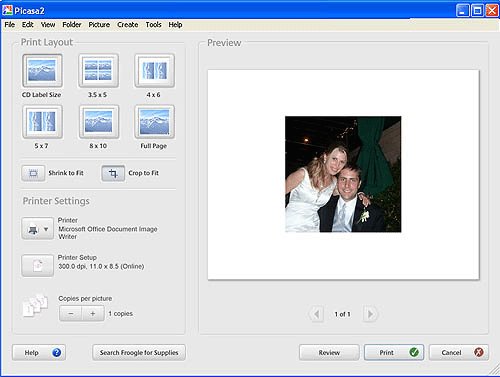
In the top menu, go to to Tools > Options > Printing, select CD Label Size and click OK. Set CD Label as your layout size and print.
You're done -- and now I'm done with my thank-you "work." I'm happy to report the photo CDs were a big hit.
Girl of the Month: Japanese Model/Actress Tomoka Kurotani
Tomoka Kurotani is the Girl of the month for November! Here's a short profile;
 Name: Kurotani Tomoka
Date of Birth: 11 December 1975
Height: 170cm
Star Sign: Sagittarius
Blood Type: O
Dramas
HOTMAN 2 (2004)
HOTMAN (2003)
Itoshi Kimie
Tengoku e no Kaidan
Hikon Kazoku
Mukashi no otoko
Big Wing
Eien no ko
Kinyoubi no Koibitotachi e
Shinryounaikai Ryouko
Miss Cinderella
Toumei ningen
Ai wo kudasai


Name: Kurotani Tomoka Date of Birth: 11 December 1975
Height: 170cm
Star Sign: Sagittarius
Blood Type: O
Dramas
HOTMAN 2 (2004)
HOTMAN (2003)
Itoshi Kimie
Tengoku e no Kaidan
Hikon Kazoku
Mukashi no otoko
Big Wing
Eien no ko
Kinyoubi no Koibitotachi e
Shinryounaikai Ryouko
Miss Cinderella
Toumei ningen
Ai wo kudasai
Wednesday, October 26, 2005
A must-see TV archive
One of the things that absolutely blew me away when I came on board last year as chairman of the Television Academy Foundation was the Archive of American Television, which is an unequaled collection of videotaped interviews with TV legends.
It's a fantastic resource, and so it drove me crazy that the Archive had over 450 interviews -- but no one could view them if they weren’t actually in Southern California. If a student at a school in Cincinnati or Bangkok wanted to learn more about the history of creative or business aspects of the American television industry, these interviews were just not accessible. So I made it a personal goal to find a way to get the Archive online.
And starting today, anyone in the world can go to Google Video and watch complete and uncut Archive interviews and learn directly from the legends and pioneers on how it all happened. How cool is that?
It’s been 30 years since I was in college, but I can honestly say that if I were just starting out in this business, I would be all over the Archive. I’m such a fan of television that I can’t wait to be able to watch some of the interviews on Google Video – with the men and women who inspired me, and continue to inspire me. One of the Archive legends now online is former NBC head Grant Tinker. Grant helped create “Must See TV” on Thursday nights! There’s also Norman Lear, Ted Turner, Steven Bochco, and so many more. The Archive was created to educate, entertain, and inspire future generations. I challenge you to look up your favorite TV show, learn about a favorite star, or discover more about some of the most important news events of the 20th century. I’m thrilled that the Foundation is finally able to introduce some of these interviews to the world, using the world’s most powerful delivery system – Google. Enjoy!
Update: added URL
Subscribe to:
Posts (Atom)
